An end of week recap
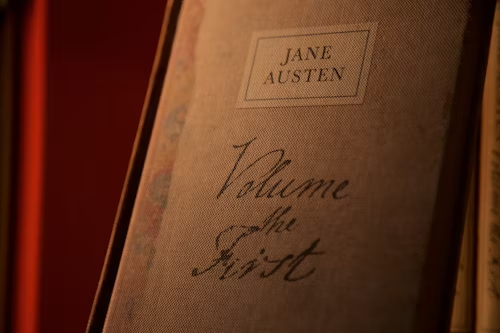
“There is a stubbornness about me that never can bear to be frightened at the will of others. My courage always rises at every attempt to intimidate me.”
– Jane Austen (born 16th December 1775)
 Wishing a joyful Hanukkah to those celebrating from sundown on 14th December to nightfall on 22nd December. 🕎
Among today’s birthday celebrants are Scottish poet, William Drummond (1585), German poet, writer and literary critic, Heinrich Heine (1797) and American-Canadian writer of crime fiction, Ross Macdonald (1915). Sunday’s birthday bunch includes English writer, poet, translator and spy, Aphra Behn (1614), Scottish travel writer, James Bruce (1730), French poet and a founder of the Surrealist movement, Paul Éluard (1895) and the American writer known primarily for her works of horror and mystery, Shirley Jackson (1916).
Spiritual Literacy Month is observed in America every December. Established in 1996 by Frederic and Mary Ann Brussat, the event aims to inspire individuals to learn about spirituality through books and personal contemplation.
Although not specifically linked to readers and writers, I feel sure it will interest wind uppers to learn that on Worldwide Candle Lighting Day, which this year falls on 14th December, people light candles at 7:00 pm local time to honour children who have passed away, forming a global wave of remembrance. It is also National Cat Lovers’ Month in the USA. 🐈
As ever, this is a post in which I summarise books read, reviewed and currently on the TBR shelf. In addition to a variety of literary titbits, I look ahead to forthcoming publications, see what folk have on their nightstands and keep readers abreast of various book-related opinions and happenings.
CHATTERBOOKS >>
If you are planning a reading event, challenge, competition, or anything else likely to be of interest to the book blogging community and its followers, please let me know. I will happily share your news here with the fabulous array of bibliowonks who read this weekly wind up.
* Three-Ring (Thing) Circus *
 The return of Three Things, my sporadic post covering all manner of things I’ve recently read, watched and done, is where I hold forth on matters both serious and silly. This edition, covering autumn/early winter, mostly concerns a handful of favourite reads, a week of loud bangs, shocked sparrows and intense sunshine in Portugal, and a brief summation of 2025 along with a few thoughts about where I am hoping to take Book Jotter in the coming months. You are invited along for the ride. >> Read: – Three Things + #9: Into Winter Waffle >>
* Two-Tome Tolstoy in ’26 *
 Another big doorstopper event is due to start on 1st January 2026 – although, strictly speaking, it is a double-doorstopper from Nick Senger’s mighty annual Chapter-a-Day Read-Along, which will begin and end with the works of Russian novelist, philosopher and social reformer, Leo Tolstoy (1828-1910). The challenge will kick off with the great author’s “widely beloved Anna Karenina”, and this will continue until 27th August before switching to his “later and more spiritually searching novel, Resurrection”, which will run until the end of the year. Nick invites you “to experience these novels alongside [him] at [a] gentle, contemplative pace”, which isn’t quite so daunting as you might imagine because “Tolstoy’s chapters are typically very short, which makes them perfect for [the] daily schedule.” If you would like to know more, please head over to his introductory post, Announcing the 2026 Leo Tolstoy Chapter-a-Day Read-Along to grab a graphic and gen-up on the finer details of taking part in this epic #TolstoyReadalong.
* Blogs from the Basement *
 My latest expedition into the dusty bowels of WUTW’s subterranean library turned up a couple of likely reads for December. (1) In the first, we journey back five years to read Jen’s appraisal of Nancy Mitford’s 1932 festive classic, Christmas Pudding (for Books on the 7:47). It is a tale, in the words of its writer, of ‘sixteen characters in search of an author’ whose “lives entwine over the Christmas period.” While not quite as Christmasy as Jen was hoping, it does permit an amusing “glimpse” into the bosom of “upper-class social circles” of this period. You can find out why, for characters such as Lady Bobbin and Amabelle Fortescue, it isn’t all “mince pies and jolliness” by clicking on Review: Christmas Pudding by Nancy Mitford. (2) “On the surface, it’s a madcap, absurd little novel about a sharp-tongued girl tearing through Paris while trying (and failing) to ride the Métro. But underneath all the surreal humour and wordplay is something darker — and far more unsettling”, says Kim Forrester in her review (from last April) of Raymond Queneau’s 1959 French classic Zazie in the Metro. Head over to Reading Matters and read ‘Zazie in the Metro’ by Raymond Queneau (translated by Barbara Wright) to find out why the protagonist “isn’t your typical child character.”
* Lit Crit Blogflash *
This is where I share my favourite pieces of writing from around the blogosphere. There are a great many talented people producing high-quality book features and reviews, which makes it mighty difficult to pick only one – in this case, posted in the last week or so:
 The Worst of Marxism, Psychoanalysis, and the Musical Theater – In her reflections on Alexander Stille’s The Sullivanians: Sex, Psychotherapy, and the Wild Life of an American Commune, Josie Holford tells us that although it is “a very readable book,” it is also a “sordid shocking story […] of “the Sullivanian therapy cult that operated in Manhattan from the 1950s until its collapse in 1991”. This non-fiction account perfectly “demonstrates the extraordinary capacity of human beings […] to be drawn into believing the veriest nonsense and to behave in ways utterly at odds with who they once were” – in this case, its members were convinced their families were “the enemy” and the group’s higher-ups promised to “free [them] from the oppression of parents, monogamy, and capitalism.” Josie’s post is the more fascinating because she personally knew individuals who were inducted into this “secretive, self-perpetuating closed system”. Please do read her intriguing piece at Rattlebag and Rhubarb for the parallels she draws with our modern-day, all-too evident, “bouts of collective unreason”.
* Irresistible Items *
Umpteen fascinating articles appeared on my bookdar last week. I generally make a point of tweeting/x-ing (not to mention tooting and bsky-ing) a few favourite finds (or adding them to my Facebook group page), but in case you missed anything, here are a selection of interesting snippets:
****************************
 NPR: A dying woman chooses friends over her husband in ‘Some Bright Nowhere’ – “A woman with a terminal diagnosis asks her husband to leave the house in Ann Packer’s new novel. Some Bright Nowhere is an absorbing book about end-of-life care and what the living owe the dying”, says book critic, Maureen Corrigan.
Jane Austen’s World: Coming Soon: Birthday Tales for Jane Austen’s 250th – You are invited to celebrate 250 years of Jane Austen with To Mark the Occasion: Birthday Tales for Jane Austen’s 250th (edited by Zarilda Belle Frost), ‘a thoughtful collection of birthday tales inspired by her unforgettable characters.’ Vic tells us: “All proceeds from this anthology will be donated to [the] Jane Austen Literacy Foundation.”
Murder at the Manse: Festive fatalities 🎄– Adam Thomas, our favourite Welsh pastor who loves nothing more than a good murder, has now put up his Christmas tree, opened the doors on his Advent calendar and is busily rehearsing carols in church, so he feels it’s about time “to read some stories about people being murdered at Christmas.”
Newcity Lit: The Brilliant and Beleaguered Journey of Margaret C. Anderson, Publisher of The Little Review – Keir Graff reviews Adam Morgan’s biography of Margaret C. Anderson, the notorious American lesbian who was arrested and put on trial in 1921 for publishing James Joyce’s Ulysses: A Danger to the Minds of Young Girls: Margaret C. Anderson, Book Bans, and the Fight to Modernize Literature.
Advocating for the Ignorant: In Praise of the Middlebrow – Sarah Harkness is delighted to discover “that what [she loves] best is middlebrow” or to “be more specific, middlebrow interwar, and written by women.” Here she praises The British Library Women Writers Series – and (since he’s a series consultant) gives a mention to our very own Simon Thomas of Stuck in a Book.
The MIT Press Reader: 20 Japanese Words for Rain – in this article adapted from Water of the Sky: A Dictionary of 2,000 Japanese Rain Words, Miya Ando discusses “turning picture and prose into a poignant meditation on nature’s impermanence.”
The Seaboard Review of Books: Planet Earth: Stories by Nicholas Ruddock – “For readers who are tired of wading through four or five-hundred-page novels, but who still like a hit of fiction,” Robin McGrath recommends Planet Earth: Stories by Canadian writer Nicholas Ruddock, a collection of “18 short stories, every one of which packs a wallop.”
Asian Review of Books: “Called by the Hills: A Home in the Himalaya” by Anuradha Roy – “Best-known for her award-winning novels,” Anuradha Roy’s Called by the Hills: A Home in the Himalaya, an intimate portrait of moving from Delhi to live on the edge of a Himalayan forest, “goes beyond the boundaries of memoir and travelogue to examine the shifting life of a Himalayan valley through both anthropological and social lenses”, writes Kabir Deb.
Cultural Capital: The Death of English Literature – “The rise and fall of [James Marriott’s] favourite subject”. Here he reviews Stefan Collini’s “wry and compendious new history”, Literature and Learning: A History of English Studies in Britain.
 Words Without Borders: “An Inexpressible Void”: Exile and Longing in Carlos Manuel Álvarez’s False War – In False War, newly translated by Natasha Wimmer, this panoptic novel of young Cubans in exile captures their “collective isolation” and “untethered lives” […] broken apart, admixed, and rearranged,” says Cory Oldweiler.
Palatinate: A Christmas game: medieval literature and Yuletide hauntings 🎄– “Yuletide in the medieval period is full of monstrous attacks” – Amelia White breaks down the associations between the monstrous and Christmas in Sir Gawain and the Green Knight.
Readings: 2025 Australian Debut Highlights – “Readings’ bookseller and chair of judges for The Readings New Australian Fiction Prize 2025 Teddy Peak shares some of the year’s best debut novels from Australian authors.”
Vox Femina Books: Why Rebecca West Left World War I Off the Page – “Do men and women depict war—most notably, World War I—differently?” asks Brittany Lloyd. “Absence”, she suggests, “might be the most feminine way of seeing war.”
4Columns: Berlin Childhood Around 1900 – Sasha Frere-Jones describes Walter Benjamin’s recently republished Berlin Childhood Around 1900 (translated by Shierry Weber Nicholsen) as a “recollection of moments at the confluence of individual memory and collective history” in “thirty-two pieces”.
The Conversation: Twenty experts on the book that got them through their 20s – part one – Twenty academic experts recommend the book that got them through their 20s, “providing direction during a decade that can sometimes feel rudderless.”
Five Books For: Five Books For Mystery Connoisseurs – “If you’ve finished off all the Agatha Christies, read all of Sherlock Holmes, Peter Robinson and Ian Rankin, are tired of Morse or Gamache and feel like trying something new,” then Kate Lillie may be able to help. “From Russia to Iceland, via Japan and Denmark, [she’s here to suggest] five fantastic detective stories, all with irresistible mysteries and clever solutions.”
Heavy Feather Review: Fiction Review: Ria Dhull Reads Osvalde Lewat’s Novel The Aquatics – Osvalde Lewat, the Cameroonian filmmaker best known for her sociopolitical documentaries, has recently released her debut novel examining “the laws and social structure of Zambuena, the fictional African country within which The Aquatics takes place.” It is described here by artist and critic Ria Dhull as a “striking work.”
RÚV: No more Icelandic novels published – “Never before have more Icelandic novels been published, based on the listings of printed books in the Book Gazette. There is also an increase in the publication of children’s books”, reports Ingvar Þór Björnsson.
 Ancillary Review of Books: Never-Ebbing Story: Review of Eva Meijer’s Sea Now – It is the dry humour of Dutch writer “Eva Meijer’s Sea Now—a story entirely focused on water—that most struck [Jake Casella Brookins].” Translated from the Dutch by Anne Thompson Mel, this climate fiction novel is also “mesmerizing and deeply humane”, told from a “mosaic of perspectives”.
The Irish Times: ‘Christmas is never complete unless I re-read it’: Irish bookworms’ recommendations 🎄– “Authors, booksellers, books influencers and podcasters share their ideal titles to give as gifts”.
WBUR: There is more than books in my Little Free Library – In her childhood home, writer Meaghan Shields family struggled, surviving on what other people didn’t want or need. But her mother was the most generous person she knew.
The Broken Compass: The writer’s bookshelf: Francesca Peacock – This week Mathew Lyons asks eight questions of British writer, journalist and critic, Francesca Peacock – “author of the critically acclaimed [biography] Pure Wit: The Revolutionary Life of Margaret Cavendish”.
Hyperallergic: Louise Bourgeois’s Life Was as Monumental as Her Art – “Writing one of the first comprehensive biographies of a major artist could prove daunting, but taking on Bourgeois’s long life in art might be called heroic.” Bridget Quinn on Marie-Laure Bernadac’s Knife-Woman: The Life of Louise Bourgeois, translated by Lauren Elkin.
3:AM Magazine: Peekaboo Bosh – John King’s “unusual novella”, Peekaboo Bosh, is crammed with “subterfuge, multiple identities, masking, and violence”, which “run beneath the surface of a narrative [bristling] with ideas and stylistic devices”, writes Ben Richards of a book dedicated to those who “risk their lives, their liberty, and their sanity in the defence of non-human animals”.
The Observatorial: A previously unknown painting by Tove Jansson called A View of Töölönlahti is being sold at the Bukowskis auction in Helsinki 🎩👜 – A previously unknown painting by Tove Jansson, View from Töölönlahti, which was completed in 1941, is to be sold at the Bukowskis auction in Helsinki.
Economical with Fiction: Paint, Permits and a Post-War Housing Crisis: Noel Streatfeild’s Forgotten Novel of Making Do in Mayfair – E.J. Barnes rereads Grass in Piccadilly, the English novelist, Noel Streatfeild’s ingenious 1952 novel set in post-war London.
The Rumpus: Books That Made Me Gay: “The Haunting of Hill House” by Shirley Jackson – “The mansion, introduced in the novel’s famous and enchanting first paragraph as, “Hill House, not sane,” is a home with a foreboding facade, an unhappy history, and walls set at angles all ever so slightly wrong.” Tess McGeer on the 1959 horror classic, The Haunting of Hill House by Shirley Jackson.
 Chicago Review of Books: Traitorous Magic in Garro’s “The Week of Colors” – Mexican writer, Elena Garro (1916-1998), “wrote among the milieu of Jorge Luis Borges, Adolfo Bioy Casares, and Gabriel García Márquez”, says Leah Rachel von Essen. “An early crucial figure in the then-burgeoning genre of magical realism, her works have gone under-translated and under-appreciated. The Week of Colors, originally published in 1964 as La semana de colores, is finally translated by Megan McDowell.”
The Book Case: The Top 3 Book Picks of 2025 from 10 Canadian Book Coaches – The “first of three special issues this week, featuring the favourite reads” of ten book coaches of Canada.
The National: Sheikha Bodour’s search for a queen offers revealing self-portrait of leading cultural thinker – Sultan Al Qassemi reviews Let Them Know She is Here: Searching for the Queen of Mleiha by Sheikha Bodour Al Qasim, daughter of the ruler of the Emirate of Sharjah, who writes of her journey from the peaks of Kilimanjaro to the sands of Mleiha in a quest to uncover the lost history of a queen.
Washington Independent Review of Books: Restitution – D.A. Spruzen describes Tamar Shapiro’s Restitution as “an engaging debut novel” and “a story of division and reunion, not only of a family but of a nation: Germany.”
Nippon.com: Yanagita Kunio: Master of Japanese Folklore and Legends – “Known for The Legends of Tōno, which includes stories of mysterious creatures and encounters with the dead, Yanagita Kunio established the field of folklore studies in early twentieth-century Japan”, writes Ishii Masami.
The Ink-Stained Desk: Apocalyptic Horror: From Plague to Post-Nuclear Wasteland. – In the latest installment of C M Reid’s Genre Genealogy series she traces “the roots and influences” of apocalyptic horror – or “the story of humanity’s end or near-end, and its aftermath”.
Sunday Times ZA: Here are the winners of the 2025 Sunday Times Literary Awards – The award, in partnership with Exclusive Books, marks the 35th anniversary of [South Africa’s] non-fiction and 24 years of the fiction prize.” The winners are Khumisho Moguerane and Shubnum Khan.
The Newtown Review of Books: LYN DICKENS Salt Upon the Water. Reviewed by Ann Skea – Salt Upon the Water, “Lyn Dickens’s award-winning debut novel of an independent woman in colonial South Australia explores prejudice, power and identity.”
Three Percent: The Promise of the Backlist – Publisher of Open Letter Books and editorial consultant for Dalkey Archive Press, Chad W. Post, explains the importance of a strong backlist for non-profit presses and reveals “a new project that kicks off with [South African author] Ingrid Winterbach’s To Hell with Cronjé.”
 World Literature Today: World Literature Today’s 75 Notable Translations of 2025 – Michelle Johnson presents a selection of seventy-five “notable translations” in an end-of-year-list. The featured title is A Compass: On the Navigable Sea: 100 Years of World Literature, edited by Daniel Simon and described in the blurb as a ‘landmark collection of fiction, essays, poetry, and reviews [commemorating] a century of exploration through pen and ink’ (from the archives of WLT).
Traveling in Books: Book Review: The Tower and the Ruin – “In his new book, The Tower and the Ruin: J.R.R. Tolkien’s Creation, Dr. Michael D.C. Drout sets out to explore […] what is it about Tolkien’s work that makes it stand head and shoulders above so many others”, says Kim.
BBC News: Author Sophie Kinsella remembered as a ‘wonderful, warm woman’ – Sophie Kinsella, the British author of the bestselling Shopaholic series of novels, died on Wednesday at the age of 55 after being diagnosed with an aggressive form of brain cancer, reports Steven McIntosh.
Reactor: “Avoid Magic”: Le Guin’s Case for “Solitude” in the Era of Romantasy – “Weighed against the narrative perfection of a Happily Ever After, can there be pleasure in remaining alone?” asks Kristen Patterson, as she looks back at an Ursula Le Guin novelette from 1994.
Jewish Book Council: Adventures of Max Spitzkopf: The Yiddish Sherlock Holmes – “In The Adventures of Max Spitzkopf: The Yiddish Sherlock Holmes, newly translated by Mikhl Yashinsky, readers meet a brilliant [Vienna-based] detective whose escapades once thrilled Yiddish audiences across Europe”, says Leah Grisham.
The Japan News: Japan Plans to Distribute Manga Overseas Via New Platform – “The government plans to establish a domestically funded platform to distribute Japanese manga overseas by creating a consortium of industry, government and academic entities.”
Daily Mail: Harry Potter first edition which JK Rowling inscribed to friends with ‘You Know Who’ two weeks before book was available in shops in 1997 could sell for £150,000 – Harry Howard reports: “A rare Harry Potter first edition which JK Rowling inscribed to a friend has emerged for sale for a whopping £150,000.”
Mid Theory Collective: Unwanted Reading: A Review of Tom Comitta’s ‘People’s Choice Literature’ – Tom Comitta’s People’s Choice Literature: The Most Wanted & Unwanted Novels is, says John Downes-Angus, “a two-part novel (or, rather, a two-novel novel)” created “using data […] collected to determine what kind of fiction Americans most and least want to read.” Apparently, “The Most Wanted novel is a tightly plotted, 250-page thriller about criminal activity in the tech world” and “The Most Unwanted novel is a 400 page experimental novel about aristocrats who live on Mars”.
Literary Hub: How Colette Was Inspired By Her Many Cats 🐈 – “Susannah Fullerton on the French writer’s feline muses”.
****************************
FINALLY >>
If there is something you would particularly like to see in Winding Up the Week or if you have any suggestions, questions or comments for Book Jotter in general, please drop me a line or comment below. I would be delighted to hear from you.
Thank you for taking the time to read this post. I wish you a week bountiful in books and rich in reading.
NB In this feature, ‘winding up’ refers to the act of concluding something and should not be confused with the British expression: ‘wind-up’ – an age-old pastime of ‘winding-up’ friends and family by teasing or playing pranks on them. If you would like to know more about this expression, there is an excellent description on Urban Dictionary.
>> See my monthly digest at the Book Jotter Journal on Substack. >>
Categories: Winding Up the Week
Yet another cornucopia of goodies, thanks! I was drawn to A Christmas game: medieval literature and Yuletide hauntings’ for its Gawain and Green Knight references, and particularly pleased that a study of the place of the monstrous in our psyche by Jeffrey Jerome Cohen got a mention as it’s a book I value for its insights into how and why we like to frighten ourselves.
As the 16th is Austen’s sestercentennial it seemed apt for me to be posting an overview of her juvenilia before embarking in her final novel, Persuasion; so I appreciated your highlighting the date among your links. 😊
Thank you, Chris. I appreciate you letting me know about your favourite bits.😊👍
Um…crikey! (Thanks Paula.)
It’s a pleasure, Josie. Great piece! 😊
It’s always so delightful to read about yet another Streatfeild novel I haven’t ever heard of before! Thanks.
I’m ashamed to say, I’ve yet to read anything by Noel Streatfeild. Perhaps ’26 will be the year that I do! 🤔
Wow. A Tolstoy read-a-thon? Going to have to join in that one I think. Also I so love the Winter Waffle.
Thank you, Frances. I enjoyed reading your Christmas-themed Three Things. Good luck with the festive shopping! 🤭
Haha. Thank you Paula.
Goodness, wonderful links again Paula – thank you! Tempted by the Tolstoy readalong, but when I do go back to him I want it to be a title I’ve not read before.
I can’t believe there’s anything of Tolstoy’s you haven’t read, Kaggsy! 😮
Thank you. I’ve added Some Bright Nowhere to my TBR and I’m off to peruse the Readings and World Literature lists.
Have a wonderful week
Thank you, Shelleyrae. You too! 😄
Thanks so much for highlighting the British Library Women Writers article – I had missed that!
You’re very welcome, Simon. 😊👍
I love Michelle Johnson’s contributions to World Lit Today (not that I should pick favourites in any way, as I have loved the whole mag for so long…it might be my most favouritest) and that list was deadly for my TBR. Also loved reading about two books you’ve linked to in particular: The Book of Colors and False War. In my “cart” now!
Oops! I shouldn’t encourage you, really… 🤭